BRAND LAUNCH
Launching a private label brand
Heres how to start your very own private label brand, product based brand in 2026.

Launch your own Amazon private label brand with an experienced operating team or bring in the exact specialist support your existing brand needs to grow.
Private label only. Independent ownership. Clear scopes of work.
ILLUSTRATIVE BRAND CONCEPT · NOT CLIENT WORK OR ACTUAL RESULTS















THE WORK BEHIND THE BRAND
Explore the decisions, moving parts, and deliverables involved in building an Amazon private label brand from the first market question to ongoing operations.
Before a product exists, we need a reason for it to exist. We investigate the market, buyer frustrations, and the competitive landscape to identify opportunities worth evaluating.
Select the product ideas worth modeling before committing capital.
An Amazon private label brand is much more than a product listing. It takes a coordinated team, a defined operating plan, and continuous decisions backed by data.
You remain the owner. SourceViora helps build, launch and manage the moving parts of your private label business from early research to ongoing operations.
Here is what working with our team is designed to give you:
Your brand, Seller Central account, inventory and intellectual property stay under your control, subject to the agreed ownership terms.
Demand, competition, differentiation, product costs and realistic margins are examined before committing to inventory.
From samples and supplier communications to manufacturing reviews, shipping, packaging and FBA preparation.
Product presentation, listings, keyword strategy, initial advertising and fulfillment readiness work together.
We monitor advertising, inventory, account health, conversion and operational priorities as your brand evolves.
Review sales alongside advertising costs, product expenses, inventory exposure and profitability not revenue alone.
SOURCEVIORA / CLIENT EXPERIENCES
Watch their stories & Read Their Feedbacks.
BRAND LAUNCH
Heres how to start your very own private label brand, product based brand in 2026.
PRODUCT DEVELOPMENT
Detail discussion on Amazon private Label FBA product development
SALES
Mistakes to Avoid
FBA PRIVATE LABEL
For Amazon FBA Business - Best Company Type (LLC. vs. S Corp) Save on Taxes!
Know Before Starting
Everything You Need to Know Before Getting Started
I wanted to diversify my investments into e-commerce, but I simply didn’t have the 40+ hours a week required to manage listings, suppliers, and shipping. Partnering with the SourceViora FBA automation team allowed me to build a legitimate digital asset completely hands free while I focused on my corporate career.
As a busy mom running a consulting business, time is my most valuable asset. Investing in SourceViora's Amazon FBA automation gave me a turnkey store that grew in the background. Seeing consistent monthly distributions without having to touch a single box or handle customer service has been a total game changer.
I was highly skeptical about the 'done for you' e-commerce model at first. But after reviewing SourceViora's transparent supply chain data and seeing the initial inventory scale up, the results spoke for themselves. They turned a complex retail arbitrage system into a seamless, automated cash flow stream for my portfolio.
The beauty of Amazon FBA automation is the sheer scalability. I didn't want a side hustle; I wanted a scalable business enterprise. By leveraging the SourceViora expert team's existing infrastructure, product research, and logistics network, my store hit six figures in volume much faster than if I had tried to learn the algorithm solo.
Building a store from scratch involves a massive learning curve and a high risk of making costly mistakes. Handing the reins over to SourceViora meant bypassing the trial and error phase entirely. They handle the operations, and I look at the macro growth it’s the perfect partnership.
For me, it came down to expertise. The Amazon marketplace changes its rules daily. Having SourceViora's dedicated team of FBA professionals actively optimizing my inventory, managing supplier relationships, and protecting my store health means my capital is working efficiently while I sleep.
Strong operations show up in more than sales. Explore revenue and profitability together, by product category, with the reporting period and underlying economics made clear.
| Product category | 12-month revenue | Net profit margin |
|---|---|---|
| Home & Kitchen | $35.0 M | 20% |
| Beauty & Personal Care | $23.3 M | 24% |
| Fitness & Outdoor | $11.7 M | 18% |
| Pet Accessories | $9.5 M | 22% |
| Office Accessories | $8.5 M | 23% |
| Garden & Outdoor | $7.1 M | 25% |
| Travel Accessories | $6.4 M | 23% |
| Car Accessories | $5.3 M | 20% |
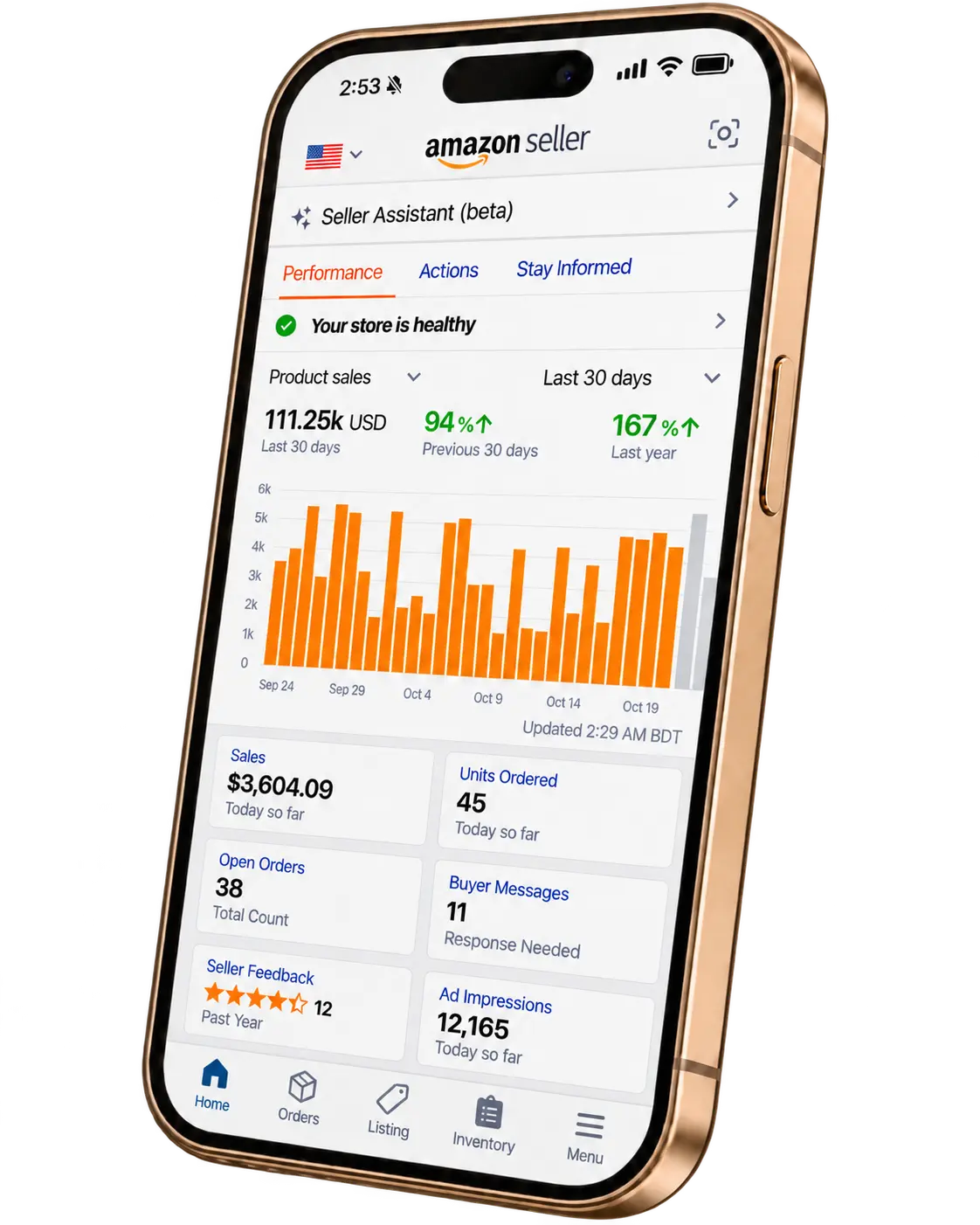
Select a report to explore the original watermarked Seller Central view.
Anyone can show Screenshots? Let us show you live numbers
Book a Free Strategy CallBehind each product decision is a team of researchers, brand builders, sourcing specialists, advertising professionals and client coordinators. Meet the people who turn a complex launch into organized, accountable work.

SOURCEVIORA TEAM
Co-Founder & CEO
Leads SourceViora's strategic direction, shaping business expansion, operational excellence, and long term partnerships while ensuring every department remains aligned with the company's vision.

SOURCEVIORA TEAM
Chief Operating Officer
Directs daily business operations, coordinates departmental execution, and strengthens operational efficiency to ensure private label projects progress through defined milestones.

SOURCEVIORA TEAM
Head of Admin & HR
Leads administrative operations and human resource management, overseeing talent development, workforce planning, organizational policies, and employee engagement to build a productive, high performing workplace.

SOURCEVIORA TEAM
VP of Sourcing & Logistics
Oversees supplier sourcing, manufacturing coordination, freight planning, and FBA shipment logistics, focusing on product quality, landed costs, and supply chain efficiency.

SOURCEVIORA TEAM
VP of Sales
Leads client acquisition strategy, sales development, and prospective client relationships, connecting ambitious entrepreneurs with private label solutions aligned with their business goals.

SOURCEVIORA TEAM
VP of Listings
Leads Amazon listing strategy, keyword optimization, product content development, and conversion focused improvements to strengthen product visibility and marketplace presentation.

SOURCEVIORA TEAM
Chief Technical Officer
Leads the company's technology strategy, overseeing website infrastructure, digital systems, technical innovation, and secure solutions that support operational efficiency.

SOURCEVIORA TEAM
Chief Financial Officer
Oversees financial planning, cost management, profitability analysis, and financial reporting to support informed decisions and sustainable private label business growth.

SOURCEVIORA TEAM
Finance & Accounts Manager
Manages financial records, transaction tracking, expense documentation, and account reconciliation to maintain accurate reporting and support financial accountability.

SOURCEVIORA TEAM
Chief Growth Officer
Drives SourceViora's company wide growth strategy, identifying expansion opportunities, strengthening market positioning, and aligning business development initiatives with long term organizational objectives.

SOURCEVIORA TEAM
VP of Client Growth
Guides client account development through sales performance analysis, advertising insights, inventory coordination, and growth strategies focused on long term brand performance.

SOURCEVIORA TEAM
Assistant Admin Officer
Supports administrative operations, staff coordination, office documentation, and internal scheduling to maintain an organized, productive working environment.

SOURCEVIORA TEAM
General Manager
Connects strategic planning with daily execution, guiding team performance, resource coordination, and cross department collaboration to maintain consistent service standards.

SOURCEVIORA TEAM
Assistant General Manager
Supports operational leadership through workflow supervision, departmental coordination, and performance monitoring, helping teams maintain execution quality and project timelines.
BEHIND SOURCEVIORA
A closer look at the environment and coordinated team behind our Amazon Private Label FBA work from research and sourcing to creative development, launch, and ongoing optimization.



Most Amazon private label struggles come from fragmented execution. SourceViora brings the moving parts together through one structured operating system designed for launch, management, and long term brand growth.
Trying to manage product research, sourcing, branding, listing optimization, PPC, inventory planning, and customer issues alone usually leads to slow progress and inconsistent execution.
SourceViora coordinates the full private label workflow through a structured operating system, so strategy, execution, and optimization stay aligned from launch to scale.
Many agencies only handle one area such as PPC, creatives, or listings without taking responsibility for the full brand economics, supply chain, or long term direction.
We connect research, sourcing, branding, listing assets, advertising, and inventory planning under one team so decisions are made with the full business in view.
Work spread across disconnected freelancers often creates handoff issues, weak accountability, uneven quality, and delays in decision making.
With SourceViora, one coordinated team manages milestones, approvals, communication, and execution giving clients a clearer process and stronger accountability.
Choosing products based on hype, intuition, or surface level trend interest can lead to weak margins, intense competition, and poor launch performance.
We evaluate opportunity through market demand, differentiation, margin structure, sourcing feasibility, and brand potential before moving capital into execution.
Many sellers launch first and try to fix issues later, which often leads to stock problems, inefficient ad spend, creative bottlenecks, and unstable profitability.
Our approach is built around phased execution validation, development, launch, and optimization so growth happens with better visibility and stronger control.
In many business models, clients are unclear on what they truly control, what assets they own, and who is responsible when performance challenges appear.
SourceViora is built around clear scopes, documented deliverables, defined approvals, and client visibility across brand assets, operational activities, and decision checkpoints.
If Any Stage Of Your Launch Does Not Meet The Agreed Scope & Milestones Within Our Agreement Terms, We Step In To Resolve It Under Our Defined Accountability Process.

You own 100% of the asset from day one. Your Seller Central account, brand registry, and inventory stay under your control.
We offer this because we run the day to day operations ourselves, only launch products we validate with real market data, and treat every brand as a long term partnership, not a one time transaction.
Every deliverable, approval gate, and fee is locked in before you commit capital. We can't promise overnight riches, but we can promise transparent execution, real unit economics visibility, and a team completely aligned with your outcome.
How SOURCEVIORA works
There is a full operating journey behind every well managed Amazon private label business. Our framework connects research, product development, sourcing, fulfillment, launch and ongoing improvement with clear work and approvals at each stage.
Not a guaranteed timeline or earnings formula an organized view of the work involved.
Turn an initial idea into a research backed opportunity before committing to production.
Clarify owner goals, available capital, ideal customer, timeline and responsibilities.
Study buyer demand, competing offers, search behavior, reviews and product gaps.
Model manufacturing, freight, Amazon fees, advertising, margin and cash reserves.
Move from a promising opportunity to a differentiated, commercially viable product.
Define specifications, useful product improvements, packaging concepts and sample tests.
Compare factories, quotations, minimum orders, terms, lead times and quality standards.
Coordinate naming, packaging, trademark steps and category-specific requirements.
Coordinate production, Amazon readiness and product discovery before the first sale.
Track manufacturing milestones, inspections, corrective actions and packing standards.
Coordinate shipping, labeling, preparation, shipment plans and inbound visibility.
Create positioning, search focused copy, product imagery and eligible enhanced content.
Manage the moving parts after launch instead of treating the first sale as the finish line.
Structure Amazon Ads campaigns, monitor search terms and refine bids and conversion.
Review replenishment forecasts, account health, reviews, returns and support trends.
Assess contribution margins, advertising efficiency, working capital and new SKU ideas.
SOURCEVIORA / SELLER TOOLS
01 / PRODUCT ECONOMICS
Better decisions begin with clearer numbers. Amazon fees vary by ASIN, size measurements, season and account conditions. Confirm the final fees before committing capital.
Book a Free Strategy CallSOURCEVIORA / QUESTIONS ANSWERED
Explore practical answers about Amazon Private Label FBA, product development, sourcing, brand management and our approach to operating with clients.
Yes, an elite e-commerce asset management firm can function as your absolute, turnkey operations engine. Under a co-managed joint venture agreement, the client provides the foundational working capital and maintains 100% legal ownership of the entity, while the agency’s centralized corporate office floor executes all product sourcing, supplier negotiations, listing optimization, PPC management, and daily logistics.
Launching a durable Private Label brand requires matching your capital structure to global supply chain realities. A realistic, high trust launch requires an upfront corporate setup fee of $5,000 to fund initial deep data mining, product engineering, and factory negotiation pipelines, paired with a dedicated inventory capital buffer of $15,000 to $20,000. Attempting to launch with less leads to stockouts, collapsed organic search rankings, and wasted ad spend.
Lower tier freelance services often charge cheap hourly rates but offer zero performance guarantees and carry high account health risks. Premium full service corporate managers operate on a co-managed model, typically charging an upfront setup fee of $5,000 to fund initial deep data mining, product engineering, and factory negotiation pipelines, paired with a performance based 60/40 profit split (60% to the investor, 40% to the manager). This aligns the manager's incentives completely with your actual storefront profitability.
Yes. SourceViora serves two types of clients: entrepreneurs who want a full private label brand launch with ongoing management, and existing private label sellers who need a specific service. Established sellers can discuss support for PPC, listing optimization, product research, sourcing, and inventory strategy without purchasing the full launch package. The appropriate scope, deliverables, reporting, and fees should be agreed before work begins. Use the consultation form to describe your current store, goals, and priorities.
Absolutely not. Granting primary login credentials or full master access to an individual freelancer is a severe security risk that exposes your banking data and business settings. Professional operators protect your business by utilizing a strict Zero Financial Access model. The manager never holds your capital; instead, you grant heavily restricted User Permissions mapped through secure, fingerprint isolated antidetect systems to handle daily tasks while you maintain absolute account and funding control.
Starting an Amazon private label business involves more than opening a Seller Central account. Define your target customer, research demand and competitors, validate product economics, assess suppliers, order and test samples, confirm compliance obligations, and develop the brand identity. After selecting manufacturing terms, plan inventory, shipping, packaging, listings, and a launch budget. Amazon Brand Registry is a separate enrollment process with trademark requirements. Build a timeline with decision gates and contingency funds so you can pause or revise an opportunity before committing to a large production order.
A first sale may occur soon after a listing becomes buyable and inventory is available, but no reliable 24 or 48 hour guarantee exists. Timing depends on listing quality, Buy Box eligibility, pricing, demand, reviews, advertising, stock status, and how quickly Amazon receives and makes inventory available. Advertising can introduce a product to shoppers, but clicks do not automatically produce orders or organic rankings. Plan the launch around inventory readiness, a testing budget, conversion monitoring, and a structured process for refining the offer based on actual customer behavior.
Professional management significantly drives sales velocity by executing data driven scaling strategies that individuals cannot match. By running deep competitor mapping, optimizing ad placements, and leveraging direct factory sourcing lines to cut product costs, a corporate backend engine increases inventory margins, protects keyword rankings, and maximizes profit output.
Yes. While Amazon handles the end consumer delivery via the FBA framework, you still need to manage the intensive upstream supply chain. A full service operations manager coordinates directly with freight forwarders, audits custom clearance documentation, handles sea/air shipping logistics from international ports, and monitors warehouse arrival timelines without you ever needing to touch a box.
A self-managed beginner frequently takes 12 to 18 months to break even due to trial and error mistakes and bad sourcing data. Storefronts backed by an enterprise co-managed floor typically target a break even timeline of 4 to 6 months. This rapid payback acceleration is achieved by executing compressed 45 day product production runs and driving dominant page one organic keyword placements immediately upon launch.
A new private label listing needs accurate product identifiers or an eligible exemption, correct category and attribute data, high quality images, compliant claims, pricing, and appropriate variation relationships. The seller also needs an inventory and shipping plan that matches Amazon's current FBA requirements. Check category restrictions, product safety documentation, and brand eligibility before publishing. Listing quality affects discoverability and conversion, but no backend configuration guarantees rank or approval. Use Seller Central's current workflow and review the final listing carefully before making inventory available for purchase.
Income expectations vary wildly based on product choices, niche selection, and capital efficiency. While beginner sellers often struggle due to high advertising costs and bad sourcing margins, professional private label stores backed by high capacity data miners regularly capture healthy net profit margins. With proper inventory scaling and optimized overhead, a private label brand functions as an exceptionally strong cash flow asset for investors.
To secure Amazon Brand Registry, you must first file a verified trademark application with the USPTO or your local government intellectual property office. Once your pending serial number is issued, you submit a formal application inside Amazon’s Brand Registry portal. A professional manager guides you through this process to quickly unlock premium platform features like A+ Enhanced Brand Content and video ads.
For a beginner, launching a Private Label brand requires navigating a complex multistage pipeline: deep market research, factory validation, sample testing, customs clearance, listing design, brand registry, and launch ad runs. To navigate this safely without losing your investment capital, you should look for an enterprise joint venture partner who can manage the technical backend execution while you fund the inventory and maintain 100% asset ownership.
Common early mistakes include choosing products without validating costs, underestimating advertising and replenishment needs, ordering too much stock, ignoring compliance, and relying on an attractive sales estimate without examining profit. Running out of inventory can interrupt momentum, while excess stock creates storage expense and ties up capital. Establish realistic lead times, a reorder point, a cash reserve, and review checkpoints before launching. Good planning reduces the chance and severity of mistakes, but it cannot eliminate market, supplier, or platform risks.
The fastest and most secure method to speed up a product launch timeline is by utilizing an active, prebuilt operational footprint. While individuals take months negotiating blindly with trading companies on Alibaba, a management firm leverages direct, boots on the ground sourcing agents in key manufacturing hubs to source products, clear factory gates, and ship inventory directly to FBA centers in under 45 days.
While tools like Helium 10, Keepa, and Jungle Scout are essential for tracking market data, software alone cannot save you time if you have to log in and analyze the metrics manually every day. The absolute best way to automate your daily tasks is by delegating your entire software management pipeline to a centralized backend agency that runs these systems for you.
Enterprise level e-commerce operators leverage advanced tech stacks including Helium 10 Diamond tier for keyword analysis, SmartScout for brand metric mapping, Keepa for historical price tracking, and GoLogin paired with IPBurger residential ISP proxies to maintain absolute network isolation across their store portfolios.
Evergreen products and seasonal products have different cash flow patterns. Products with steady demand can make forecasting easier, while seasonal items may offer concentrated selling opportunities but require precise ordering and exit plans. Examine at least a full seasonal cycle when data is available, and account for storage charges, advertising peaks, returns, and supplier lead times. Neither category guarantees consistent income. Choose a product strategy based on your working capital, demand evidence, operational capacity, and ability to handle slow moving inventory.
The fastest way to move from zero to a live product listing is by utilizing a prebuilt supply chain infrastructure. Trying to research, source, edit images, and write listing copy as an individual can take 4 to 6 months. A corporate operations engine deploys parallel teams graphic designers, copywriters, and sourcing agents to compress this launch timeline to under 45 days securely.
Amazon Merch on Demand and Amazon Private Label require different types of work and investment. Merch on Demand generally shifts much of the product printing and fulfillment process to the platform, while creators focus on eligible designs and demand. Private label usually requires sourcing, inventory financing, quality control, compliance, listings, and ongoing stock management. Private label may create a broader branded business, but it also introduces greater operational and financial exposure. Choose based on the kind of assets you want to build and how much capital and management responsibility you can support.
There is no standard income for an Amazon private label seller. Revenue depends on demand, pricing, competition, inventory availability, and advertising effectiveness; profit also depends on manufacturing costs, freight, Amazon fees, returns, and operating overhead. A brand can generate substantial sales while producing little or no net profit. Evaluate a product through a full unit economics model, monitor cash flow and reorder requirements, and assess results over a meaningful period instead of relying on isolated screenshots. Historical results from another store cannot predict what a new brand will earn.
Private label and wholesale serve different objectives. Wholesale generally means reselling established brands under the rules of those brands and competing with other authorized sellers on existing product pages. Private label involves developing or sourcing products sold under a brand you control, which can provide more influence over packaging, differentiation, and positioning. Private label also requires investment in research, brand development, product compliance, inventory, and demand generation. Neither model guarantees higher margins or a faster return; compare working capital, risk, operational expertise, and your long term goals.
Amazon FBA can support profitable private label businesses, but profitability varies dramatically across products and operators. Competition, ad costs, fulfillment fees, pricing, inventory turnover, and returns all influence the outcome. FBA handles eligible storage, picking, packing, and shipping; it does not choose products, build a brand, or guarantee demand. Prospective sellers should assess a complete product level profit and loss model and the cash needed for replenishment before committing funds. Treat success stories as examples of what happened to specific businesses, not as typical earnings.
Amazon selling costs commonly include a selling plan fee, a category dependent referral fee, and when using FBA per unit fulfillment and storage fees. Depending on your product, other costs may include inbound placement, aged inventory, removals, returns, and optional advertising. Referral percentages are not universally 15%, and fulfillment charges depend on product characteristics and applicable rate cards. Calculate the contribution margin per unit after all variable costs, then deduct ongoing overhead to estimate net profit. Recheck current Amazon fee schedules before setting a selling price or placing an order.
Wholesale can sometimes reach an initial sale faster because a seller may join an existing listing, subject to brand and category authorization. Private label generally takes longer to develop because it may involve research, sampling, production, branding, and a new product launch. Profitability for either model depends on acquisition cost, selling price, platform fees, competitive conditions, and ongoing expenses. Private label offers greater scope to differentiate the offer, but it also places more responsibility and upfront cost on the brand owner. Compare realistic cash flow scenarios rather than assuming one model always reaches profit first.
A realistic timeline for an Amazon Private Label product launch spans roughly 4 to 6 weeks for product engineering and shipping logistics, followed by a 30 to 60 day launch optimization phase to secure page one keyword placement. Stores backed by data driven corporate managers can reach stability and consistent cash flow output significantly faster than self-managed beginner attempts.
Wholesale requires you to constantly compete with dozens of other sellers for the exact same "Buy Box" on popular brands, leading to zero pricing control and low margins. Private Label is the vastly superior business model because you register your own proprietary brand trademark. You own 100% of the listing page, control the product design, face zero inside Buy Box competition, and build a real, sellable business asset that can be acquired by institutional buyers.
A pricing decision should begin with the actual landed cost and desired contribution margin, not a fixed premium over competitors. Include Amazon referral and fulfillment fees, advertising, returns, storage, promotions, and overhead. Then compare substitute products, customer expectations, perceived differentiation, and price elasticity. A higher price may be justified by meaningful benefits, but it can also lower conversion. Test pricing carefully, monitor net margin rather than revenue alone, and avoid building the business around a universal 10–15% markup rule.
| Feature / Model | Dropshipping (High Risk) | Wholesale (Low Margin) | Private Label (Sourceviora Asset) |
|---|---|---|---|
| Buy Box Ownership | Shared / Constant price wars. | Shared with dozens of sellers. | 100% Exclusive Brand Ownership |
| Account Suspension Risk | Critically High (Policy Violations) | Medium (Brand Authorization Locks) | Extremely Low (Fully Compliant) |
| Net Profit Margins | 5% – 10% (Razor thin) | 10% – 15% (Squeezed by brands) | 25% – 40% (Highly Optimized) |
| Long Term Exit Value | $0 (Zero equity build) | $0 (Cannot sell the asset) | High (Aggregator Acquisition Target) |
The best private label product for 2026 is not one universal trend or category. Look for an identifiable customer problem, sustainable demand, achievable differentiation, a manageable compliance profile, reliable production, and enough contribution margin after advertising and FBA costs. Review search behavior, customer complaints, competitor offers, seasonality, and landed cost estimates over time. Avoid selecting a product solely because a software tool labels it 'low competition.' Products with apparently attractive sales can still be poor investments when returns, restrictions, or inventory requirements are considered.
The highest performing products on Amazon are not found by chasing viral online trends. The best private label items are uncrowded, boring, high demand everyday products within stable niches that feature low structural weight (to reduce freight costs) and healthy margins to absorb ad spend. Identifying these hidden niches requires multiweek data tracking and deep software mining across supply chains.
Product research is about finding an opportunity that can satisfy customers profitably. Start with shopper demand, search intent, competing products, reviews, customer pain points, and potential differentiation. Then test whether the proposed design, supply chain, compliance requirements, selling price, and advertising costs leave a viable margin. Product quality and customer experience matter just as much as search volume. No dataset can certify a product as a winner; research should narrow uncertainty, generate testable assumptions, and establish clear reasons to proceed, revise, or reject the idea.
Potential niches can include practical home organization accessories, specialized hobby tools, durable household essentials, or narrowly defined consumer problems. These are ideas for research, not product recommendations. Before choosing a niche, examine search demand, competitive listings, review patterns, price sensitivity, compliance obligations, seasonality, and supplier availability. 'Low competition' can mean weak demand rather than opportunity. A strong niche has a clear buyer need and a feasible way to improve the existing offer without creating an unsustainable production or advertising cost structure.
The most secure, strategic method is starting with one single, deeply validated product line. Focusing 100% of your initial launch energy, ad spend, and inventory capital into a single niche allows you to establish rank dominance and capture clear market share before using those profits to launch product line extensions.
The right niche is found by identifying high customer demand combined with low competitor listing quality. Data mining teams analyze search volume trends, extract competitor negative review patterns to fix product design flaws at the factory level, and target price points that comfortably protect your profit margins against inflationary ad costs.
Finding a safe supplier requires moving past public platforms like Alibaba, where trading companies masquerade as real factories. Institutional managers protect your product capital by deploying direct, boots on the ground sourcing operations inside major manufacturing hubs. Sourcing staff physically audit factory gates, verify manufacturing capacities, and negotiate lower production rates directly with the owners.
Validate a product idea before ordering inventory by combining customer and market research with actual supplier quotes. Estimate selling price, demand, competition, production cost, freight, duties, Amazon fees, returns, and advertising. Test samples for quality and assess whether the proposed differentiation is meaningful. Competitors' exact advertising spend and unit sales are generally not public, so treat third party estimates as approximations. Use scenario models and a documented go/no-go decision to avoid confusing optimistic software projections with confirmed economics.
The right first order balances supplier minimums, expected demand, cash reserves, manufacturing lead time, and the risk of selling out or overstocking. Estimate daily demand cautiously, then calculate weeks of cover and the total time required to reorder, inspect, ship, and receive the next batch. Include buffers for delays and Amazon receiving variability. Ordering more units can improve factory pricing but increases capital exposure and potential storage costs. For a first launch, prioritize the amount of inventory the business can responsibly finance and replenish, not a universal 60 day rule.
Many manufacturers have minimum order quantities (MOQs), but those figures can sometimes be negotiated. Ask suppliers whether a smaller trial order, fewer colors, standard components, or a simpler packaging configuration would reduce the first commitment. Compare any MOQ reduction with the higher per unit price and tooling requirements it may create. Always document specifications, lead times, quality standards, payment terms, and inspection rights. Smaller orders can limit upfront inventory risk, but they do not remove the need to validate demand and finance replenishment.
The only legitimate, Amazon compliant method to get a UPC code is by purchasing directly from the official GS1 global network registry (GS1.org). Avoid cheap, third party barcode resellers, as Amazon actively cross references your barcodes against the GS1 database. Using unverified barcodes will lead to immediate listing suppression or account health suspensions.
Yes, absolutely. Amazon's advertising algorithms are highly complex and change continuously. Self-managing ads without deep data tracking usually leads to high keyword bleed and wasted budget. Delegating your media buying to an agency ensures that certified ad specialists monitor your ad spend daily, lower your ACoS, and optimize keyword velocity to drive highly profitable sales.
Amazon PPC can help a new private label listing reach relevant shoppers while organic visibility is still developing. However, paid advertising is not mandatory in every situation, and it does not guarantee page one organic rankings. Start with a budget that the product's contribution margin and available capital can support. Organize campaigns around search intent, track search terms, conversion rates, ACoS, TACoS, and placement costs, and adjust based on actual results. Advertising works best alongside competitive pricing, credible product content, dependable inventory, and a genuinely useful offer.
Organic search visibility starts with a listing that accurately matches customer intent. Research relevant search phrases, place the strongest terms naturally in the title and product information, and describe differentiating features clearly. Images, pricing, ratings, customer experience, inventory availability, and sales performance also influence the shopper's decision. Avoid stuffing keywords or making unsupported claims. Without ads, new listings may gain visibility more slowly, so monitor indexing and traffic, then improve the offer based on observed search and conversion data rather than assuming keywords alone will create rankings.
Products usually require an appropriate product identifier such as a UPC, EAN, or another supported GTIN. When purchasing identifiers, GS1 is a recognized source and product data should match the brand and item. Some products are eligible for a GTIN exemption through Amazon's listing workflow, so it is not correct to say every private label item must purchase a UPC. Confirm the current identifier requirements for your category, brand, and marketplace before producing packaging or submitting a listing.
A standard, healthy Amazon PPC advertising launch budget requires roughly 15% to 20% of your total product retail target value to aggressively drive initial keyword rankings. Professional operators build strict keyword capping systems to ensure your ad spend acts as a direct investment into organic rank placement, rather than a continuous cash drain.
Effective Amazon product listings help shoppers understand exactly what the product is, who it is for, and how it addresses their needs. Use clear titles, accurate specifications, strong images, informative bullet points, and compliant product claims. Keyword research should support readability rather than overwhelm it. Explain relevant differences such as materials, fit, dimensions, compatibility, or packaging when substantiated. Compare performance through click-through rate, conversion, returns, and customer questions, then test improvements without assuming that any copy formula guarantees sales.
Product photography can influence how quickly shoppers understand an offer and whether they trust its presentation. Main images must follow Amazon's category specific image rules, while additional images can demonstrate scale, features, materials, use cases, and packaging. Professional photography, realistic lifestyle shots, and accurate graphics are useful when they communicate genuine product details. Avoid misleading digital alterations or unsubstantiated comparisons. Measure creative quality through conversion, customer questions, and returns as well as aesthetics; premium looking images cannot compensate for poor product market fit.
Starting with one carefully validated product can simplify forecasting, advertising, and operational learning, particularly when capital is limited. Multiple products may diversify risk and create a broader brand offering, but each SKU adds manufacturing, content, inventory, and marketing complexity. Decide based on budget, supplier minimums, product relationships, and available operating capacity. The aim is not to dominate a category immediately; it is to establish a repeatable process for evaluating product level profitability and customer satisfaction before committing to further launches.
Managing a large product catalog requires setting up clear parent-child listing variations, structured SKU naming rules, and automated inventory health sheets. Centralized operational offices utilize custom tracking dashboards to monitor stock levels and velocity across all SKUs, preventing expensive out of stock situations or storage fee spikes.
Amazon keyword research should start with customer intent rather than search volume alone. Build a list of relevant product attributes, use cases, competitor terminology, and long tail phrases, then check whether each term describes the actual item. Integrate important terms naturally into the title, bullet points, product attributes, and eligible search term fields. Monitor search query and advertising data when available, and avoid irrelevant or repetitive keywords. Strong indexing helps discoverability, but pricing, product quality, images, and conversion performance remain essential.
Amazon Brand Registry is valuable for eligible private label businesses because it provides access to brand management and protection tools, along with certain enhanced content and advertising features. It is not mandatory merely to sell products on Amazon. Enrollment generally requires qualifying trademark evidence and brand presentation that matches Amazon's rules, which can include an eligible pending application. Check the current requirements for the country and store involved. Brand Registry can help you protect and manage a brand, but it does not guarantee the removal of every unauthorized offer or counterfeit listing.
Handling a suppressed listing requires a deep understanding of Amazon’s changing Terms of Service (ToS), categorizations, and backend code. Independent assistants often make guesswork edits that escalate issues into severe account locks. Professional account managers deploy experienced compliance teams to perform code audits, fix catalog errors, and communicate directly with Seller Support through secure network tunnels to reinstate the listing immediately.
Managing customer communications at scale requires a 24/7 operational layout. Missing response windows destroys your seller metrics and tanks your Buy Box visibility. An elite operational firm runs continuous daily tracking shifts to process customer inquiries, coordinate returns, and handle tracking inquiries within minutes, protecting your platform trust score around the clock.
Amazon Seller Central registration typically requires identity and contact details, payment and banking information, tax related information, and other documents depending on the country and business type. The applicant should provide accurate, consistent information and complete Amazon's requested verification steps. An LLC or other formal entity is not universally required to open a seller account. After approval, configure account security, user permissions, tax settings, and relevant shipping or FBA options before adding products. Follow the current official registration guidance rather than workarounds that risk account restrictions.
With FBA, Amazon handles many fulfillment and return processing activities, but the seller remains responsible for monitoring account health, return patterns, product quality, and required customer support obligations. Review reasons for returns, refunds, damaged inventory, recurring defects, and buyer feedback. Distinguish fulfillment complaints from product or listing problems, then work with suppliers and content teams to address root causes. Response requirements and responsibility vary by order and program, so follow Seller Central guidance rather than assuming that all messages must be answered within minutes.
Amazon may allow eligible individuals to register without forming an LLC or other company, but legal registration, tax obligations, and permits depend on where the seller lives, operates, and sells, as well as the product category. A formal company can help with governance, contracting, banking, and liability planning, but it does not automatically eliminate personal liability. Check local business requirements, tax advice, and product specific regulations before selling. Brand Registry has separate trademark requirements and does not generally require every seller to own a US LLC.
Brand protection starts with clearly documented trademark rights, reliable product and packaging identifiers, and monitoring of suspicious listings or offers. Eligible brand owners can use Amazon Brand Registry tools to report intellectual property concerns; some additional programs have separate eligibility requirements. Gather evidence before filing a complaint, and distinguish genuine counterfeits from legitimate resale or catalog errors. Trademark registration and Brand Registry strengthen available options, but neither ensures instant removals or complete prevention of unauthorized offers. Consult qualified legal counsel when disputes are significant.
Seller account health depends on several metrics, and the relevant thresholds can differ by fulfillment method and selling program. Important areas include order defects, valid tracking where applicable, late shipment performance for seller-fulfilled orders, customer feedback, policy warnings, and product authenticity or safety complaints. FBA handles some shipping operations, but sellers still need to watch account health notices and listing compliance. Check the current Seller Central thresholds and performance pages rather than reducing all risk to three universal numbers or assuming that daily monitoring prevents suspensions.
Deep product sourcing research and daily pay per click (PPC) ad data pruning consume over 70% of standard management hours. These tasks require constant human attention, complex spreadsheet tracking, and math calculations. Delegating these time intensive tasks to a dedicated backend floor allows you to scale your business assets without taking on an operational job.
Amazon requires eligible sellers to maintain adequate commercial liability insurance when specified conditions are met, and some sellers may be required to provide proof earlier depending on their situation. For the US store, Amazon has published a $10,000 monthly gross sales trigger, subject to current policy terms. Coverage needs, policy limits, additional insured requirements, and proof of insurance should be reviewed in the applicable Amazon guidance and with an insurance professional. Insurance addresses certain liability risks; it does not guarantee that a store or its products are legally compliant in every jurisdiction.
Amazon prohibits purchasing fake reviews, offering improper incentives, and manipulating customer feedback. Eligible brands can consider official programs such as Amazon Vine and Amazon's permitted Request a Review feature. Focus first on product quality, accurate listing claims, reliable fulfillment, and a customer experience that earns genuine feedback. Use Amazon's current review request rules and avoid messaging that selectively solicits only positive experiences. A compliant process can help collect authentic reviews, but neither reviews nor ratings can be promised on a fixed timetable.
While hiring an independent Virtual Assistant (VA) seems cost-effective, it introduces massive operational risk, including unverified internet connections that can flag your account, lack of management, and inconsistent work. For a true hands off experience, the optimal alternative is a co-managed corporate backend infrastructure. By leveraging a centralized office floor with built-in management layers, you eliminate individual freelancer risk and replace it with predictable, institutional grade execution.
Independent freelancers typically handle basic data entry, simple customer service templates, or routine software scanning. However, complex growth loops require deep specialization. A professional full service management firm splits these tasks among distinct internal teams: dedicated product miners with direct factory networks in China handle sourcing, specialized media buyers manage PPC data vectors, and technical compliance staff monitor account health 24/7 out of a centralized workspace.
Finding a reliable freelance assistant on public boards is notoriously difficult due to resume padding, high turnover rates, and total lack of accountability. True operational reliability is found by partnering with an established, brick and mortar e-commerce asset management firm. Look for partners who operate out of centralized physical offices with dedicated internal management, transparent data reporting workflows, and strict data security protocols.
You can build a private label business independently or hire support for selected workstreams. Doing it yourself may reduce service fees but requires time to learn research, sourcing, compliance, listing creation, advertising, and inventory management. Specialists can add capacity and experience, while a coordinated team may reduce handoff problems across those activities. The right choice depends on your budget, skills, available time, and how much control you want over execution. Compare actual scopes, reporting, access permissions, and contract terms not simply the agency label or freelancer price.
If an independent freelance assistant makes a critical operational mistake (like setting incorrect listing data, messing up a shipping plan, or violating a policy guidelines rule), you bear 100% of the financial loss and platform penalties. By partnering with a structured corporate firm under a formal contract, your store is protected by built-in management checks and professional insurance frameworks to mitigate operational risks.
An independent Virtual Assistant (VA) is a lone freelancer working from home, providing basic labor with zero structural backing or resource access. An Amazon FBA management agency is an institutional corporate framework featuring a centralized physical office building, enterprise fiber networks, internal data tracking platforms, and specialized teams of data miners, media buyers, and compliance experts working together under a single management layer.
Before outsourcing your store operations, you should compile your historical profit and loss (P&L) statements, extract your exact lifetime ACoS data from your campaign dashboards, and check your performance notification history. A professional agency will analyze these data fields for you during your initial strategy call to map out a clear recovery plan.
Protecting your store requires strict network isolation and credential containment. Never allow remote workers to log into your account via standard browsers, as shared residential networks trigger automated cross contamination flags from Amazon. Ensure your partner runs all account activity through isolated, dedicated proxy containers and maintains a Zero Financial Access standard where they never touch your banking capital.
Trying to write your own SEO copy or design your own image layouts without professional conversion training usually results in low click-through rates and high ad costs. Passing your listing optimization to an institutional creative design floor gives you access to copywriters, keyword analysts, and graphic designers who construct high converting product pages built to maximize sales.
An elite e-commerce expert should demonstrate transparent operational capability and verifiable infrastructure. Avoid individual coaches or anonymous internet marketers. Your service partner should feature a physical corporate office location, a verifiable list of active multi store portfolios under management, an in house design and product sourcing department, and clear legal joint venture agreements.
The absolute best time to hire professional operational help is before you launch your account. Attempting to fix structural sourcing mistakes, broken product designs, or flagged account credentials later is incredibly expensive. Partnering with an institutional management firm from day one ensures your business asset is built safely underneath the platform's security algorithms.
For serious business investors looking to grow a digital asset, an agency is the only viable option. Freelancers present high turnover rates, zero legal accountability, and single point of failure risks. An agency delivers a centralized corporate infrastructure, nondisclosure data protection agreements, professional software tools, and continuous staffing redundancy so your storefront operations never stop.
Managing an international Private Label brand requires years of verified, platform specific experience across media buying, logistics, and data mining. Rather than trying to find a single individual who claims to know everything, it is significantly safer to partner with a corporate ecosystem that employs distinct, specialized professionals to manage each unique segment of your storefront.
A private label business can generate $1,000 in monthly net profit, but that amount is an outcome to model, not a realistic promise for every new seller. Start with a forecast of sell-through, selling price, manufacturing and shipping expenses, referral and fulfillment fees, returns, advertising, and overhead. Then compare the monthly contribution against inventory reorder needs and cash reserves. New listings may be unprofitable while they gather data and visibility. A credible plan includes optimistic, base, and downside scenarios rather than a fixed earnings timeline.
Stagnant sales are almost always caused by inefficient PPC ad structures or outdated listing optimization. When self management stalls, you need an objective operational audit. Transitioning your store to a professional co-managed backend office allows certified media buyers to restructure your ad targets, reduce wasted ad spend, and maximize your organic search rankings.
Self-managing a growing Amazon storefront requires roughly 25 to 30 hours per week spent on inventory monitoring, supplier negotiations, ad optimization, and customer service. For busy professionals or corporate executives, this time commitment is a major barrier. Outsourcing your operations to a dedicated white label backend manager compresses your personal time investment to under 30 minutes a week spent purely on reviewing biweekly profit distributions.
Scaling an e-commerce business requires delegating every piece of daily operational friction. True scalability is achieved through structural division of labor. By partnering with an offshore corporate manager who runs a 50 person operational floor, you can scale your brand portfolio from 1 SKU to 50 SKUs effortlessly, without increasing your personal working hours or adding to your stress levels.
After a product demonstrates sustainable demand and acceptable contribution margins, the next growth decision should follow the data. Review repeat purchase behavior, customer feedback, advertising efficiency, inventory turnover, and cash requirements. Potential extensions include related products, useful bundles, improved versions, or new sizes and variations. Every additional SKU should have its own demand validation and landed cost forecast. Expanding before cash flow and supply chain processes are stable can magnify operational problems, so use staged testing and clear performance thresholds.
Whether you're launching your first private label brand or scaling an existing one, let's explore your opportunities and build a clearer strategy together.